About
Bat Yam Museum was established in 1961 as a museum of modern art. During its first decades, it served as a venue for local modern art, with a focus on painting and sculpture. From the outset, the Museum showed a keen interest in and engagement with the life of the city. Alongside exhibitions by leading artists who lived in Bat Yam—including the sculptor Yaakov Epstein and the painter Haim Kiewe—the adjacent water tower provided studio spaces for local artists.
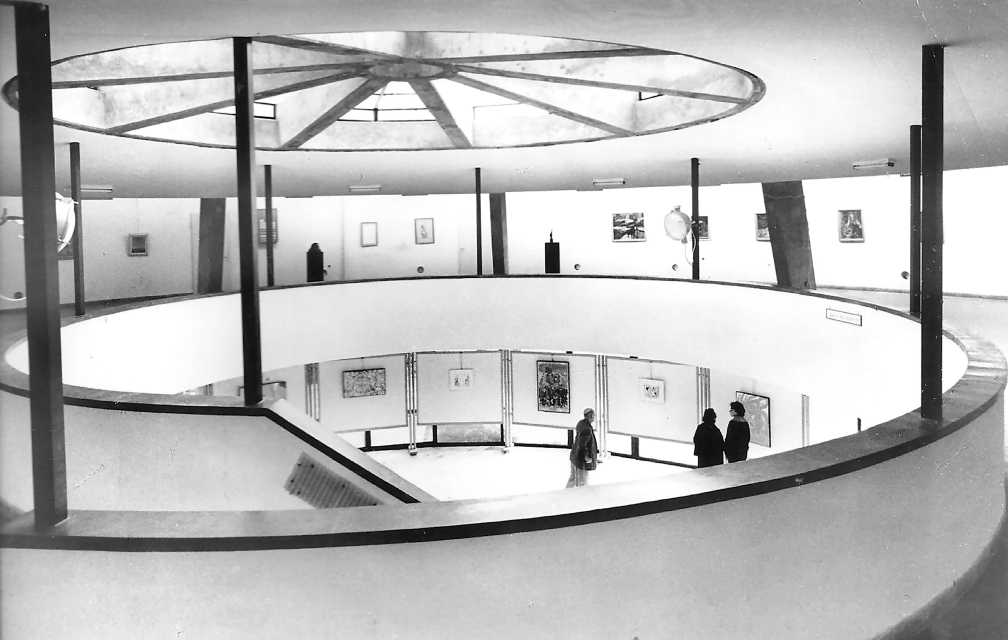
The circular modernist building that houses Bat Yam Museum of Art was designed by architect Yitzhak Perlstein. It is characterized by the Brutalist style, an architectural ethos that sought to express a building’s truth through the use of exposed concrete. The Museum’s open-plan building contains an exhibition pavilion of approximately 1,000 square meters, offering artists a broad and exceptional space in which to realize their creative visions.
The Museum was designed as part of its surrounding environment: Perlstein also designed the Ramat Yosef neighborhood, at whose heart the Museum stands. The building is situated in a pleasant, green park designed by landscape architects Lipa Yahalom and Dan Tzur, recipients of the Israel Prize for Architecture.
In 2007, the Museum reopened as part of MOBY, the Bat Yam Museums. Its opening exhibition was presented at the northern edge of the Bat Yam promenade, marking the Museum’s renewed presence in the public realm and in the life of the city. Today, the Museum presents exhibitions of contemporary art. Notable artists whose work has been shown there in recent years include Eli Petel, Ruti Sela, Shahar Yahalom, Avi Sabah, Yael Bartana, Eitan Ben Moshe, Michal Helfman, and Anna Yam.
MOBY comprises three municipal museums: Bat Yam Museum of Art, Sholem Asch House, and Issachar Ber Ryback Artist’s House. These cultural institutions commemorate the work and collections of two major artists, leading figures of the Jewish avant-garde whose lives were connected to Bat Yam.
Sholem Asch designed and furnished the house himself, and lived there from his arrival in Israel in 1955 until his death about two years later. Since 1962, the house has served as a center for culture and literature. It has housed Asch’s rare art and Judaica collections, alongside his library and personal archive.
Following an extensive renovation, which included restoring the original furniture collection and the house’s historic garden—designed in the 1950s by garden architect Meir Victor—the house reopened to the public as a cultural center offering exhibitions, literary events, and writing workshops.
In 1963, architect Yitzhak Perlstein completed Ryback House, a Brutalist building considered the only museum dedicated to the renowned Jewish painter Issachar Ber Ryback. The house also served as the home of Ryback’s widow, Sonia. It operated as a museum from 1963 until the mid-1970s. In recent years, it served as an art education center, hosting workshops and community activities. Today, Ryback House is preparing for a major renovation intended to restore its original purpose as an active museum, with Ryback’s works on permanent display.
Team | Our Collections | Join us